

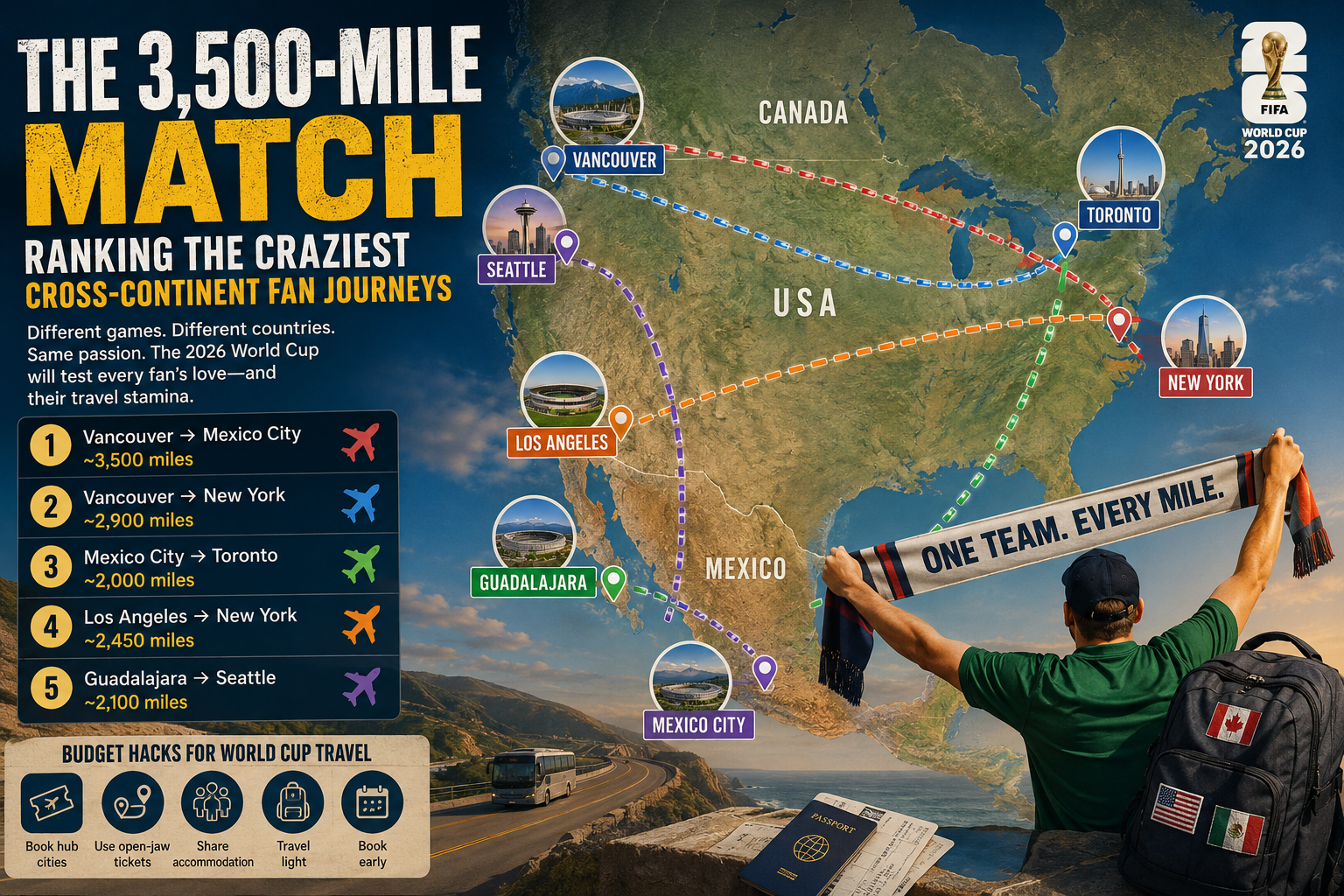
The 3,500-Mile Match: Ranking the Craziest Cross-Continent Fan Journeys
The 2026 FIFA World Cup is not just the biggest tournament in football history. It is also shaping up to be the biggest travel challenge fans have ever faced.
Read: The ‘Messi Effect’ Is Over. Here Are 5 New Legends You’ve Never Heard Of (But Will by July)
For the first time, the tournament is being hosted across three countries: the United States, Canada, and Mexico. While that sounds exciting on paper, supporters are quickly discovering that following their team could involve journeys longer than some international vacations.
From Vancouver in western Canada to Mexico City in central Mexico and New York on the U.S. East Coast, the distances are enormous. Some fans may travel more than 3,500 miles between group-stage matches alone.
So which supporters face the craziest travel schedules? Let’s rank the most extreme World Cup fan journeys.
1. The Ultimate Marathon: Vancouver to Mexico City
Distance: Approximately 3,500 miles
Imagine watching your team play in Vancouver before rushing to Mexico City for the next match.
This journey is roughly equivalent to traveling from London to Cairo. Direct flights are limited, and many supporters will need connections through major hubs such as Los Angeles, Dallas, or Houston.
For fans trying to save money, things become even tougher. Budget routes may require overnight layovers and travel times exceeding 15 hours.
Travel Difficulty Rating: 10/10
Read: 5 Nations Who Waited Forever for Their First World Cup
2. The Coast-to-Coast Sprint: Vancouver to New York
Distance: Approximately 2,900 miles
The sheer size of North America becomes obvious when comparing Vancouver and New York.
A fan could spend nearly six hours in the air and still remain within the same host region of the World Cup. Add airport security, transfers, and transportation to stadiums, and a matchday journey can consume an entire day.
Supporters attempting this route between closely scheduled games will need military-level planning.
Travel Difficulty Rating: 9/10
3. Mexico City to Toronto
Distance: Approximately 2,000 miles
At first glance, this route does not seem too intimidating.
However, crossing international borders, dealing with varying flight prices, and managing accommodation costs can quickly turn it into a logistical headache.
Fans who wait until the last minute could face airfare that costs more than their match tickets.
Travel Difficulty Rating: 8/10
4. Los Angeles to New York
Distance: Approximately 2,450 miles
This classic coast-to-coast trip is familiar to Americans, but it becomes far more stressful during a World Cup.
Hotels near stadiums will fill quickly, flight demand will surge, and supporters may find themselves competing with thousands of fellow fans for transportation.
The route itself is straightforward. The challenge is doing it affordably.
Travel Difficulty Rating: 8/10
5. Guadalajara to Seattle
Distance: Approximately 2,100 miles
This journey highlights the unique nature of a three-country tournament.
A supporter could be cheering in the heart of Mexico one week and standing in the Pacific Northwest a few days later. While flight connections are generally available, prices could rise sharply as knockout-stage scenarios become clearer.
Travel Difficulty Rating: 7/10
The Budget Hacks Fans Will Be Sharing
Not every supporter can afford premium flights and luxury hotels. Expect fan groups to exchange travel tips throughout the tournament.
Book Hub Cities Instead of Match Cities
Major airports often offer cheaper flights than smaller host cities. Flying into nearby hubs and taking trains or buses can save hundreds of dollars.
Use Open-Jaw Tickets
Instead of flying in and out of the same airport, book flights that arrive in one city and depart from another. This works particularly well for fans following teams across multiple regions.
Share Accommodation
Supporters’ groups are already discussing apartment rentals and shared lodging options. Splitting costs among several fans can dramatically reduce expenses.
Read: 4 Nations Making History at the 2026 World Cup
Travel Light
Checked baggage fees add up quickly when taking multiple flights. Many experienced football travelers rely entirely on carry-on luggage.
Follow the Fixture Release Carefully
The difference between booking six months early and six weeks early could mean paying double for the same route.
Why These Journeys Will Become Part of World Cup History
The World Cup has always been about more than the football.
Supporters remember overnight train rides, packed fan zones, missed connections, and unexpected adventures almost as vividly as the goals themselves.
In 2026, the tournament’s massive geographic scale will create stories unlike anything seen before. Fans will cross deserts, mountains, international borders, and entire time zones to support their teams.
Some will spend more time traveling than watching matches.
And when a supporter finally arrives after a 3,500-mile journey to see their nation score a late winner, every mile will feel worth it.
The road to World Cup glory is long for players. In 2026, it may be just as long for the fans.





Leave a Reply