

Predicting the Group of Death Before the Draw
Every World Cup produces one dreaded phrase: the Group of Death.
It is the group where giants collide, emerging nations are capable of shocks, and even a team with seven or eight points can find itself sweating over qualification. With the 2026 FIFA World Cup expanding to 48 teams and 12 groups, identifying the toughest group is more complicated than ever. The new format allows the top two teams from each group and the eight best third-placed teams to reach the Round of 32, reducing the chances of an outright disaster for elite nations.
Still, some groups look significantly more dangerous than others.
Using the confirmed 2026 World Cup groups, FIFA rankings, recent tournament performances, qualification form, and historical World Cup pedigree, here are the groups most likely to become the tournament’s true Group of Death.
What Makes a Group of Death?
A genuine Group of Death usually contains:
- At least two teams capable of reaching the quarterfinals or beyond.
- A third team with a realistic chance of advancing.
- Very little gap between the strongest and weakest side.
- Strong recent form backed by historical tournament success.
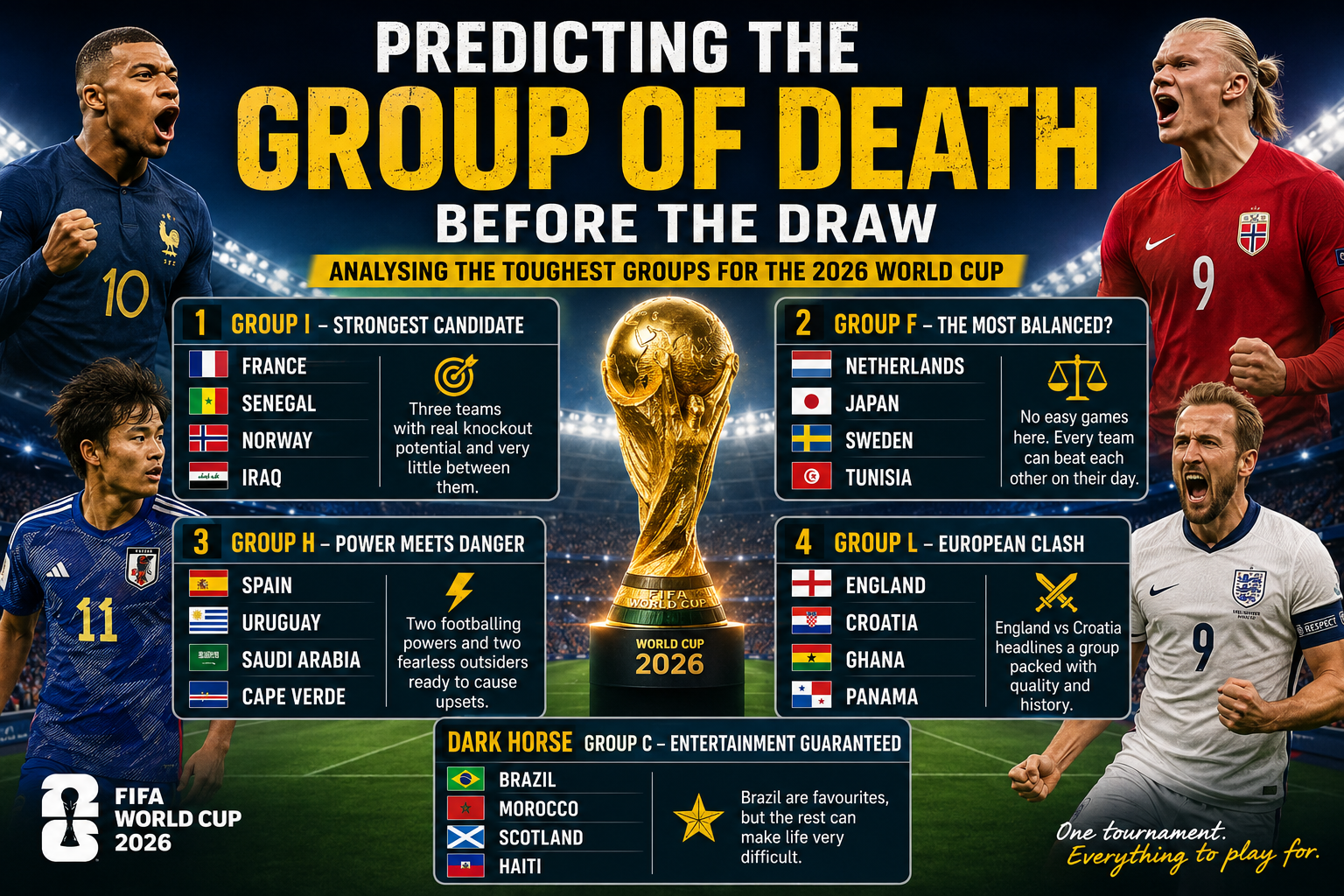
Looking at the 2026 draw, four groups stand out.
Candidate #1: Group I
France, Senegal, Norway, Iraq
This is the strongest candidate.
France remain one of the world’s elite sides and entered the tournament among the highest-ranked teams globally. They possess tournament experience, squad depth, and a proven ability to reach the latter stages of major competitions.
Senegal are no longer underdogs. They have consistently qualified for major tournaments and continue to produce players from Europe’s top leagues. Their physicality and tactical discipline make them a nightmare opponent.
Norway might be the most dangerous third seed in the tournament. With a generation led by world-class attacking talent and impressive qualification performances, they have the quality to defeat almost anyone on their day.
Even Iraq cannot be completely dismissed. Asian teams have increasingly challenged traditional powers in recent World Cups, and Iraq arrive with momentum after a successful qualification campaign.
Several independent rankings based on FIFA points and group strength calculations have already placed Group I as the toughest group in the tournament.
Prediction
- France
- Norway
- Senegal
- Iraq
The margins could be extremely small, with all three of the top teams capable of advancing.
Candidate #2: Group F
Netherlands, Japan, Sweden, Tunisia
This group lacks a traditional heavyweight like France or Argentina, but it may be the most balanced group in the competition.
The Netherlands remain one of Europe’s most consistent tournament teams. However, Japan have developed into arguably Asia’s strongest football nation and have repeatedly troubled elite European and South American opponents in recent World Cups.
Sweden possess extensive tournament experience and are rarely easy to break down. Tunisia have become one of Africa’s most reliable qualifiers and regularly produce disciplined performances against stronger opponents.
Unlike many groups where one team is clearly weaker, every nation here has a realistic route to qualification.
Prediction
- Netherlands
- Japan
- Sweden
- Tunisia
Do not be surprised if only a single point separates first and third place.
Candidate #3: Group H
Spain, Uruguay, Saudi Arabia, Cape Verde
Spain enter the tournament among the favourites according to several power rankings and global ranking systems. Uruguay remain one of football’s most dangerous tournament teams despite their smaller population.
Saudi Arabia already demonstrated in 2022 that they can shock football royalty, famously defeating Argentina. Cape Verde may be tournament newcomers, but they arrive with confidence after an impressive qualification run.
The presence of two traditional football powers automatically raises the group’s difficulty level.
Prediction
- Spain
- Uruguay
- Saudi Arabia
- Cape Verde
This group could easily produce one of the tournament’s biggest surprises.
Candidate #4: Group L
England, Croatia, Ghana, Panama
England enter as one of the tournament favourites, while Croatia continue to outperform expectations on the biggest stage. Since 2018, Croatia have reached a World Cup final and a World Cup semifinal, making them one of the most dangerous second seeds in the competition.
Ghana bring athleticism, pace, and a strong World Cup tradition. Panama are often overlooked but continue to improve and have become increasingly competitive in CONCACAF competitions.
The England versus Croatia matchup alone makes this one of the most anticipated groups.
Prediction
- England
- Croatia
- Ghana
- Panama
Dark Horse Group: Group C
Brazil, Morocco, Scotland, Haiti
Brazil are always contenders, but Morocco’s remarkable run to the 2022 World Cup semifinals changed perceptions permanently. They are no longer surprise packages. Scotland have improved significantly and recently opened their campaign with a victory, while Haiti possess enough pace and athleticism to create problems.
This group may not be the strongest overall, but it has the potential to deliver the most entertaining football.
Prediction
- Brazil
- Morocco
- Scotland
- Haiti
So Which Is the Real Group of Death?
If we combine FIFA rankings, squad quality, qualification records, and historical tournament success, the answer is clear.
Group I (France, Senegal, Norway, Iraq) is the most likely Group of Death at the 2026 FIFA World Cup.
France are genuine title contenders. Senegal are one of Africa’s strongest teams. Norway have enough talent to qualify from almost any group. The result is a group where three nations believe they should reach the knockout stage, but only two automatic qualification spots are available.
Group F and Group H are close challengers because of their balance and competitive depth, while Group L offers perhaps the biggest clash of established football powers.
One thing history teaches us is that the Group of Death is rarely decided on paper. Injuries, form, travel demands, and one moment of brilliance can transform the entire picture. Yet before the knockout rounds begin, Group I appears to be the section every team would have preferred to avoid.
And that is exactly what makes it the Group of Death.
Final Predicted Top Four
Based on the group-stage predictions in the article and historical World Cup performance, here is a realistic projected knockout path. This is not a prediction of the official bracket, but a likely scenario based on team strength, depth, and tournament pedigree.
Predicted Quarterfinals
Quarterfinal 1
France vs Uruguay
Prediction: France 2-1 Uruguay
France’s superior squad depth and attacking options give them the edge, but Uruguay’s tournament experience makes this a difficult encounter.
Quarterfinal 2
Brazil vs England
Prediction: Brazil 2-1 England
A classic World Cup showdown. Brazil’s creativity and ability to control possession help them overcome England in a tight contest.
Quarterfinal 3
Spain vs Germany
Prediction: Spain 1-1 Germany (Spain win on penalties)
Two possession-based giants collide. Spain’s younger core may have a slight edge over a German side that could face fatigue after a difficult route.
Quarterfinal 4
Argentina vs France? (Bracket conflict)
To avoid same-side clashes, a more realistic matchup:
Argentina vs Portugal
Prediction: Argentina 2-1 Portugal
Possibly the final chapter of one of football’s greatest international rivalries. Argentina’s balance across the pitch gives them a narrow advantage.
Predicted Semifinals
Semifinal 1
France vs 🇧🇷 Brazil
Prediction: France 3-2 Brazil
The match of the tournament. France’s pace in transition and strength in depth help them survive a thrilling encounter.
Semifinal 2
Spain vs 🇦🇷 Argentina
Prediction: Spain 2-1 Argentina
Spain’s midfield dominance proves decisive against an Argentine side that has battled through several difficult knockout matches.
Predicted Final
France vs 🇪🇸 Spain
Both teams possess elite talent, strong youth development systems, and recent success in major tournaments.
Prediction: France 2-1 Spain
France combine physicality, pace, experience, and tactical flexibility better than any team entering the tournament. Their squad depth becomes the difference over seven matches.



Leave a Reply